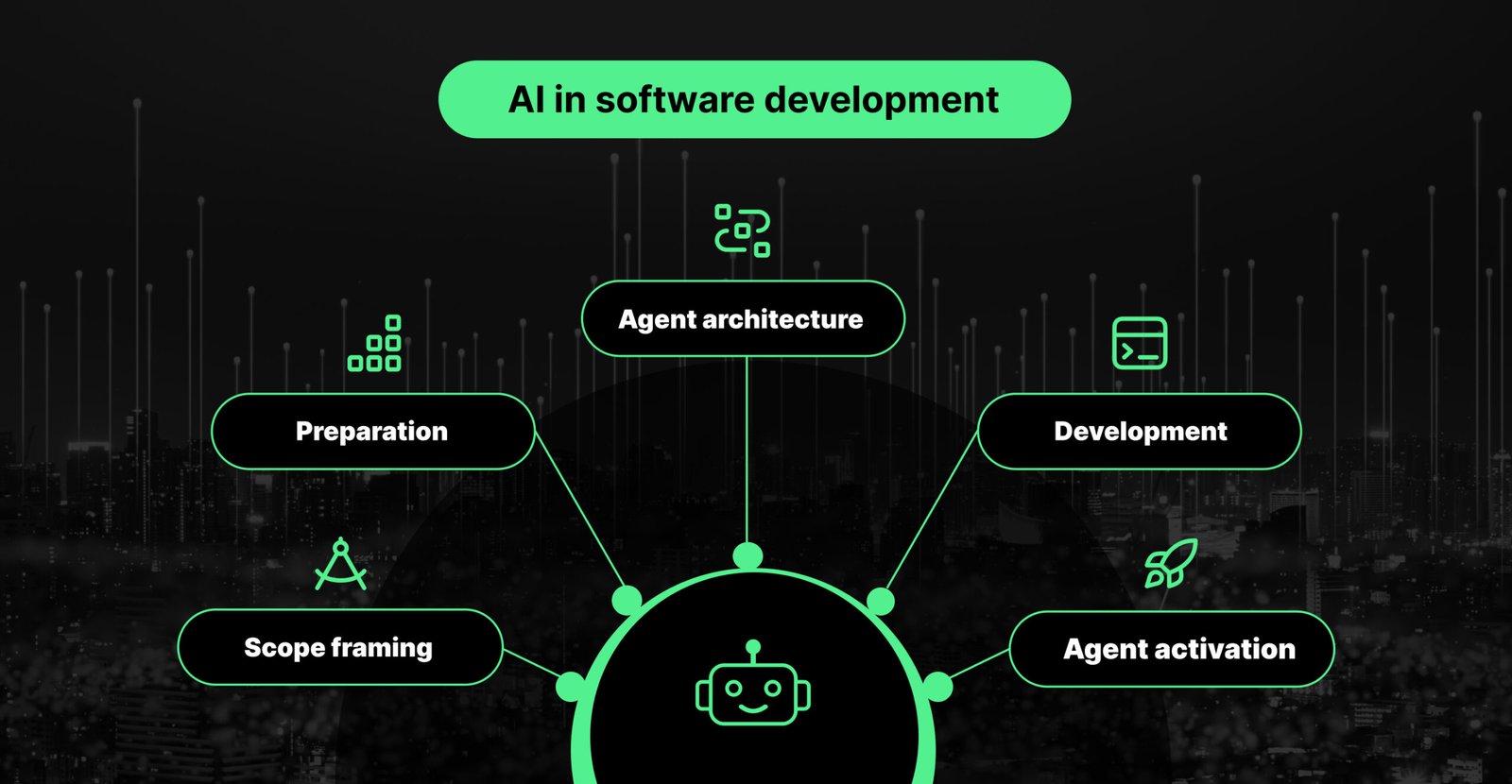
For years, AI coding tools were mainly used as smart assistants. A developer could ask for a function, generate a few lines of code, explain an error, or complete a piece of code while working inside an editor.
That is changing quickly.
The latest generation of AI coding tools is moving toward what the industry often calls agentic software development. Instead of simply responding to individual prompts, AI agents can take a larger software-development task, break it into smaller steps, work with a codebase, run tests, identify problems, and make changes with much less manual intervention.
This does not mean developers are disappearing. Instead, the role of a developer is gradually changing from writing every line of code manually to directing, reviewing, testing and improving work produced with the help of AI.
What Is Agentic Software Development?
Traditional AI coding usually follows a simple pattern:
Developer → Prompt → AI → Code
For example, a developer might ask an AI assistant:
"Create a Python function that validates an email address."
The AI generates the function, and the developer decides whether it is correct.
An AI coding agent can work differently. A developer might instead provide a broader task:
"Add email verification to the registration system, update the database structure, create the required API endpoint, add tests and fix any failing tests."
The agent can then break the task into multiple steps and work through them.
A typical workflow might look like:
Task → Planning → Code changes → Testing → Debugging → Review
The important difference is that the AI is no longer being used only as a code generator. It is being used as an active participant in the development workflow.
Why Developers Are Paying Attention
Software projects can contain thousands or even millions of lines of code. Understanding an unfamiliar project can sometimes take longer than actually writing a new feature.
Agentic tools can help developers navigate these large codebases by searching files, understanding relationships between components and identifying where a change needs to be made.
This can be particularly useful for repetitive tasks.
For example, imagine a developer needs to update an API across dozens of files. Traditionally, the developer would search through the project, make the changes, run tests and manually check for problems.
An AI agent can assist with much of that process.
The developer still needs to review the changes, but the amount of repetitive work can be reduced.
Coding Agents Can Do More Than Generate Code
One of the biggest differences between traditional AI coding assistants and coding agents is the ability to interact with development tools.
Depending on the platform, an agent may be able to:
Read and search project files
Create or modify source code
Run commands
Execute tests
Inspect error messages
Make corrections
Work with Git repositories
Create documentation
Review changes
Help investigate bugs
This creates a more complete development loop.
Instead of asking an AI one question at a time, developers can give it a goal and allow it to work through several related tasks.
AI Does Not Remove the Need for Developers
The growing capabilities of coding agents have also created an important misconception: that software developers will no longer be needed.
In reality, writing code is only one part of software development.
Developers still need to understand the requirements, architecture, security, performance, user experience and business logic behind an application.
AI can generate code that looks correct but still contains problems.
For example, an AI-generated application could have:
Security vulnerabilities
Poor database design
Inefficient queries
Incorrect business logic
Weak error handling
Dependency problems
Unexpected edge cases
This is why human review remains important.
A developer who understands the system can identify problems that may not be obvious from the generated code.
Testing Is Becoming Even More Important
As AI becomes capable of producing larger amounts of code, automated testing becomes increasingly valuable.
A developer can ask an AI agent to implement a feature, but the resulting code still needs to be verified.
Unit tests, integration tests, security testing and code review can help determine whether the changes actually work as expected.
This creates an interesting relationship between AI and testing.
AI can help write tests, but those tests themselves need to be meaningful. A poorly designed test can simply confirm that incorrect code behaves in the same incorrect way.
Human oversight therefore remains an important part of the process.
What This Means for Junior Developers
Agentic development could have a significant impact on people who are learning programming.
Beginners now have access to tools that can explain errors, generate examples and help them build projects much faster than before.
At the same time, relying completely on AI can create a serious problem.
A developer may be able to build an application without understanding how the underlying code works.
That can become a problem when something breaks.
Learning programming fundamentals is therefore still important. Understanding data structures, algorithms, databases, networking, operating systems, security and software architecture gives developers the ability to evaluate AI-generated code rather than simply accepting it.
The Future of Software Development
Agentic coding is still developing, and the way developers use these systems will continue to change.
The likely future is not simply "AI writes everything."
Instead, software development may become more collaborative:
Human defines the goal → AI handles implementation tasks → Automated systems test the work → Human reviews and makes final decisions
This could allow developers to spend more time thinking about architecture, product ideas, user problems and complex engineering decisions while AI handles more repetitive implementation work.
The biggest change may not be the disappearance of programming. It may be the changing definition of what it means to be a programmer.
Knowing how to write code will remain valuable, but knowing how to design systems, verify AI-generated code and give AI agents clear technical instructions could become equally important.
Final Thoughts
Agentic software development represents another step in the evolution of AI-assisted programming.
The technology is becoming capable of handling increasingly complex development tasks, but that does not make human developers irrelevant. Instead, it gives them another powerful tool to work with.
The developers who understand both software engineering fundamentals and AI-powered development tools may be in a strong position as these workflows become more common.
For now, the most practical approach is simple: use AI to move faster, but understand and test the code before trusting it.
AI Coding Is Moving Toward Agentic Software Development