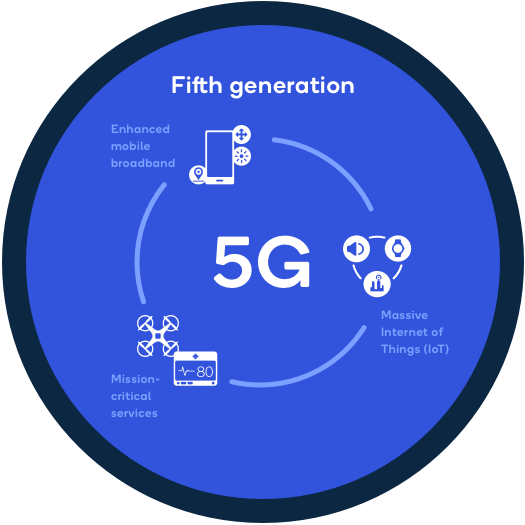
5G, or the fifth generation of mobile network technology, is designed to provide faster wireless connectivity, lower latency, improved network capacity, and support for a growing number of connected devices. Mobile networks have evolved significantly from earlier generations, with each generation introducing improvements in speed, reliability, communication, and the types of services that can be supported. While 4G helped make high-speed mobile internet, video streaming, online gaming, and app-based services common, 5G is designed to support even more demanding applications and a much larger number of connected devices. The technology is becoming an important part of modern telecommunications and is expected to influence smartphones, smart devices, businesses, transportation, entertainment, and other connected technologies.
One of the main features associated with 5G is higher data speed. Depending on network conditions, spectrum, device capabilities, and other factors, 5G networks can provide significantly faster connections than previous mobile technologies. Faster connectivity can make activities such as downloading large files, streaming high-quality video, using cloud applications, and transferring data more convenient. However, actual speeds can vary considerably depending on the mobile operator, location, network congestion, available spectrum, device hardware, and signal conditions.
Another important feature of 5G is lower latency. Latency refers to the time required for information to travel between a device and a network system. Lower latency can be particularly useful for applications that require quick communication between connected devices and servers. Online gaming, remote control systems, industrial automation, augmented reality, virtual reality, and certain connected transportation applications may benefit from reduced network response times. The practical experience will still depend on the complete network infrastructure and the specific application being used.
5G is also designed to support a large number of connected devices. This is particularly important as the Internet of Things continues to grow. Smart sensors, security systems, connected appliances, industrial equipment, vehicles, and other devices can communicate through wireless networks. As more devices become connected, networks need to manage large volumes of communication efficiently. 5G technologies are being developed to support different types of connectivity requirements across consumer and industrial applications.
Smartphones are currently one of the most visible applications of 5G technology. Modern 5G-compatible smartphones can connect to supported 5G networks and take advantage of available network capabilities. Faster mobile connectivity can improve activities such as video streaming, large file downloads, cloud gaming, video conferencing, and accessing cloud-based applications. However, having a 5G smartphone alone does not guarantee a specific speed because performance also depends on network coverage, operator infrastructure, spectrum availability, location, and other technical factors.
The development of 5G is also connected with the growth of cloud computing and edge computing. Many modern applications depend on remote servers for processing and storage. Edge computing moves some processing closer to the location where data is generated, potentially reducing the distance information needs to travel. Combined with suitable 5G infrastructure, this approach can support applications that require fast communication between connected devices and computing systems.
Businesses are exploring 5G for a variety of purposes. Manufacturing companies can use connected sensors and machines to monitor equipment and production processes. Warehouses can use connected devices to track inventory and operations. Retail businesses can explore connected systems for stores and logistics, while organizations in transportation can investigate connected vehicle and traffic-management technologies. The exact benefits depend on the industry, network infrastructure, and how the technology is implemented.
5G may also play a role in smart-city development. Cities can use connected sensors and communication systems to collect information about traffic, public infrastructure, environmental conditions, energy usage, and other services. This information can potentially help organizations monitor infrastructure and manage certain services more efficiently. However, large-scale smart-city systems also require appropriate data protection, cybersecurity, infrastructure investment, and planning.
Entertainment and gaming are other areas that can benefit from improved mobile connectivity. Faster networks can make it easier to stream high-quality video and access cloud-based gaming services. Augmented reality and virtual reality applications may also benefit from improved connectivity and lower latency. These applications can require significant amounts of data and quick communication, making network performance an important factor in the overall user experience.
Despite its potential advantages, 5G also has limitations and challenges. Building advanced mobile networks requires significant investment in infrastructure, including base stations, antennas, fiber connections, spectrum, and other network equipment. Coverage can also vary between locations, particularly when different frequency bands have different propagation characteristics. In some areas, users may continue to experience a combination of 4G and 5G connectivity depending on network availability.
Cybersecurity is another important consideration as more devices become connected to mobile networks. A larger number of connected devices can create more potential points that need to be secured. Network operators, device manufacturers, application developers, and users all have roles to play in maintaining security. Software updates, secure authentication, appropriate access controls, encryption, and responsible data management can help reduce certain security risks.
5G is also expected to work alongside other technologies rather than completely replacing them. Wi-Fi, fiber broadband, 4G networks, satellite communication, and other connectivity technologies will continue to serve different purposes. In many situations, the best technology depends on the location, application, cost, required speed, coverage, and infrastructure available.
The future development of 5G will depend on network expansion, technological improvements, device availability, business adoption, and the development of applications that can take advantage of its capabilities. As networks become more advanced, 5G may support an increasing number of connected services and applications. Its impact will likely be influenced not only by network speed but also by how businesses and developers use the technology to create practical solutions.
5G represents an important stage in the development of mobile communication technology. By offering the potential for higher speeds, lower latency, greater capacity, and support for large numbers of connected devices, it provides a foundation for many modern digital applications. From smartphones and entertainment to industrial systems, smart devices, cloud services, and connected infrastructure, 5G is becoming part of the broader digital ecosystem. As adoption continues, understanding both its capabilities and its limitations will help users and businesses make informed decisions about connected technologies.
5G Technology Explained: How Faster Mobile Networks Are Changing the Digital World