

Introduction: A Step Towards Autonomous Marine Technology in India
In the rapidly changing world of science and technology, one name that shines bright is IIT Bhubaneswar. Known for pushing the boundaries of innovation, the institute has once again made headlines by developing an unmanned boat and an underwater drone. These groundbreaking inventions are designed to transform marine exploration, aquatic biodiversity research, data gathering, and pollution monitoring across India’s vast coastal and inland water systems.
As the world faces growing concerns about climate change, water pollution, marine biodiversity loss, and the need for sustainable exploration, such innovations are not just academic achievements—they are real-world solutions. The IIT Bhubaneswar unmanned boat and underwater drone project represents a giant leap toward creating autonomous systems that can operate reliably in challenging aquatic environments without direct human intervention.
By leveraging advanced sensors, cutting-edge navigation technology, artificial intelligence, and IoT integration, researchers at IIT Bhubaneswar have designed a system capable of performing critical tasks—from mapping ocean floors to monitoring pollution levels and even supporting national defense.
This article explores the depth of this innovation, the technology behind it, its impact on marine exploration and pollution monitoring, and why it positions India as a rising leader in autonomous marine systems.
What is an Unmanned Boat?
An unmanned boat, also called an autonomous surface vehicle (ASV), is a watercraft that can navigate and operate without a crew onboard. Instead of being controlled by sailors, it uses AI algorithms, GPS systems, sensors, and communication modules to move independently or under remote guidance.
The IIT Bhubaneswar unmanned boat has been designed with multiple objectives in mind:
- Marine exploration: Conducting surveys of rivers, lakes, and oceans.
- Pollution monitoring: Measuring water quality, detecting chemical/oil spills, and identifying microplastic presence.
- Data gathering: Collecting temperature, salinity, and oxygen levels from different aquatic zones.
- Defense & security: Patrolling sensitive coastal regions or supporting naval surveillance.
What makes this unmanned boat unique is that it’s not just a research prototype—it is a practical, cost-effective solution for India, where long coastlines and inland water systems demand constant monitoring and management.
What is an Underwater Drone?
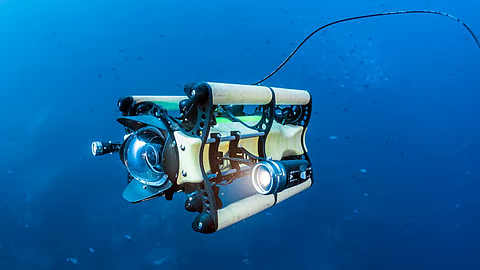
The second part of IIT Bhubaneswar’s innovation is the underwater drone, also known as an autonomous underwater vehicle (AUV). Unlike unmanned boats that float on the water’s surface, underwater drones explore beneath the surface, reaching depths where human divers cannot easily go.
The IIT Bhubaneswar underwater drone is equipped with:
- High-resolution cameras for capturing visuals of aquatic life and underwater terrain.
- Advanced sensors for measuring dissolved oxygen, turbidity, and pollutants.
- Navigation technology like sonar and GPS-aided tracking systems.
- Autonomous control that allows it to avoid obstacles and follow pre-programmed routes.
Its applications extend from marine exploration of coral reefs and aquatic biodiversity to pollution monitoring in rivers where industrial waste is a concern.
By combining the unmanned boat and underwater drone, IIT Bhubaneswar has effectively created a dual-layer marine exploration system—one that can scan the surface and simultaneously explore the depths.
The Technology Behind IIT Bhubaneswar’s Innovation
The strength of this project lies in its integration of multiple technologies:
- Advanced Sensors
- Measure pH levels, temperature, turbidity, salinity, oxygen levels.
- Detect oil spills, toxic chemicals, or microplastics.
- Navigation Technology
- Surface boat uses GPS + AI algorithms to chart routes.
- Underwater drone uses sonar mapping and inertial navigation for precise movement.
- Artificial Intelligence & IoT
- Data collected is analyzed in real-time.
- Can be shared with cloud servers for remote monitoring and decision-making.
- Communication Systems
- Unmanned boat communicates via satellite or wireless signals.
- Underwater drone uses acoustic communication to stay connected with the boat or control station.
- Energy Efficiency
- Designed with solar-assisted systems for longer surface missions.
- Rechargeable high-capacity batteries power the underwater drone.
This unique blend of AI, sensors, IoT, and navigation technology ensures that the IIT Bhubaneswar unmanned boat and underwater drone can work efficiently even in challenging conditions like high currents, murky waters, or remote coastal zones.
Applications in Marine Exploration
The ocean is often described as Earth’s final frontier. With more than 80% of the underwater world still unmapped, IIT Bhubaneswar’s innovation could become a game-changer for India’s scientific community.
Some key marine exploration applications include:
- Ocean Floor Mapping – Creating 3D maps of seabeds.
- Biodiversity Studies – Observing fish schools, coral reefs, and endangered species.
- Archaeological Exploration – Identifying submerged ruins or shipwrecks.
- Hydrological Studies – Measuring ocean currents, tides, and sedimentation patterns.
By using both the unmanned boat for surface data and the underwater drone for depth analysis, scientists can gain a comprehensive view of aquatic ecosystems.


 By
By